Projects
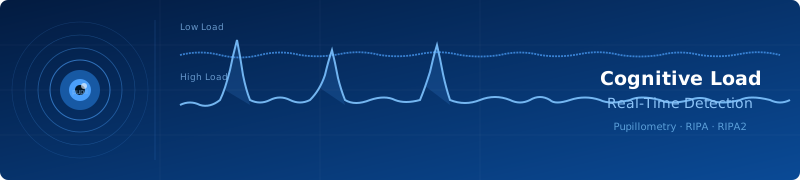
Real-Time Cognitive Load Detection via Pupillometry
2022 – present
Developed real-time algorithms to measure cognitive load using pupil diameter oscillations.
Introduced RIPA (Real-time Index of Pupillary Activity) and its enhanced successor RIPA2,
validated across structured N-back memory tasks and naturalistic information search scenarios involving fact-checking.
RIPA2 incorporates refined Savitzky–Golay filter parameters to better isolate pupil fluctuations within
biologically relevant frequency bands linked to mental effort, demonstrating improved sensitivity
over offline pupillary activity indices.
Demonstrated improved sensitivity over the established offline LHIPA benchmark, enabling cognitive monitoring during naturalistic tasks without post-hoc data collection.
Related Publications
Measuring Mental Effort in Real Time Using Pupillometry
— Journal of Eye Movement Research, 18(6), 2025
Toward a Real-Time Index of Pupillary Activity as an Indicator of Cognitive Load
— KES 2022 – Procedia Computer Science
Effects of Working Memory Capacity and Search Task Complexity on Cognitive Load
— CHIIR 2026
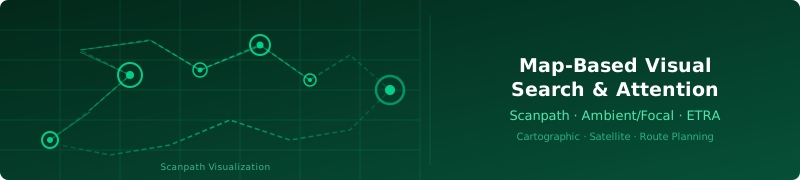
Eye Movement Analysis in Map-Based Visual Search
2025 – present
Investigates how map type (cartographic vs. satellite) and task type (location finding vs. route planning)
influence scanpath complexity and cognitive load. Developed a real-time method to compute the ambient/focal
coefficient K — a validated gaze measure of attention mode — enabling adaptive interfaces without
post-hoc analysis. Demonstrated that scanpath complexity varies across task–map combinations,
reflecting strategic shifts in visual search behavior.
Enabled adaptive interface support without post-hoc analysis, showing that task–map pairing meaningfully shapes gaze strategy and should be a design variable in spatial information systems.
Related Publications

Cognitive Load, Bias & Credibility in Text Relevance Assessment
2024 – present
Examines how confirmation bias, document relevance, and information credibility influence
cognitive load during reading and relevance assessment. Applies the Low/High Index of Pupillary
Activity (LHIPA) via eye-tracking to capture mental effort associated with processing relevant vs.
irrelevant content and truthful vs. misleading information. Findings reveal systematic differences
in cognitive load tied to both relevance and bias, with implications for adaptive information retrieval.
Showed that both document relevance and prior belief (confirmation bias) independently modulate mental effort, providing physiological grounding for bias-aware information retrieval design.
RAEMAP
2019 - present
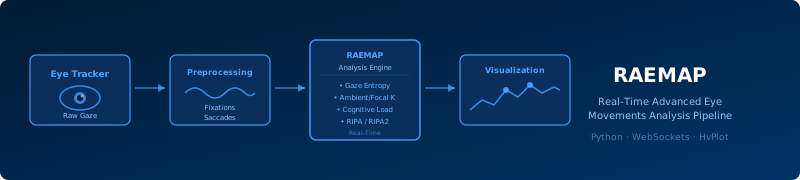
Real-Time Advanced Eye Movements Analysis Pipeline (RAEMAP) is an advanced pipeline to analyze traditional positional gaze measurements as well as advanced eye gaze measurements.
The implementation of RAEMAP includes real-time analysis of fixations, saccades, gaze transition entropy, ambient/focal viewing coefficient, and real-time measure of cognitive load.
RAEMAP provides visualizations of generated advanced gaze measures in real-time.
Unified previously siloed gaze metrics into a single streaming platform, making real-time cognitive monitoring accessible to researchers without signal-processing expertise.
Joint Visual Attention and Joint Mental Effort in Collaborative Learning
2023
Explored the relationship between joint visual attention and joint mental effort in collaborative learning environments by conducting a data analysis of eye tracking datasets from three studies in collaboration with Dr. Bertrand Schneider from Harvard University, Cambridge, MA.
Analyzed joint visual attention and joint mental effort, and how they support collaboration in terms of collaboration quality and learning gains from previous experiments.
Found that joint visual attention and shared mental effort are distinct predictors of collaboration quality, suggesting eye-tracking can serve as a real-time proxy for productive collaborative engagement.
Detect Cognitive Load in Real-Time using Pupillary Activity
2022
Re-designed and implemented the Low/High Index of Pupillary Activity (LHIPA), an eye-tracked measure of pupil diameter oscillation to function in real-time, in collaboration with Dr. Andrew Duchowski from Clemson University.
The novel Real-time IPA (RIPA) is shown to discriminate cognitive load in re-streamed eye-tracking data from previous experiments.
Proved that real-time cognitive load discrimination is achievable from a live pupil stream, bridging the gap between offline academic measures and deployable adaptive systems.
GROBID based Scholarly PDF Header and Full Text Extractor
2021 & 2022
Designed and developed a software to extract header information such as title, abstract, keywords, authors, affiliations, and full text from scholarly PDF documents in real-time and process extracted data.
Goal was to populate LANL’s Review & Approval System, RASSTI’s forms with extracted data.
Reduced manual data-entry burden for LANL reviewers by automating the ingestion of scholarly document metadata directly into RASSTI’s review workflow.
Automate Filtering of Eye Movements
Designed a study to detect dynamic Areas of Interest (AOIs) using computer vision—specifically object detection and instance segmentation models (e.g., YOLO, Mask R-CNN) to identify moving objects in videos and map gaze data to them.
This method automates AOI detection in dynamic stimuli like video streams, eliminating the need for manual input and improving real-time gaze analysis.
Eliminated the manual annotation bottleneck that had restricted eye-tracking analysis to static stimuli, opening the method to video-based and naturalistic gaze research.
Analyze Performance of Adolescents with ADHD Using Eye-Tracking
Conducted a pilot study to assess audiovisual Speech-In-Noise (SIN) performance of adolescents with ADHD compared to age-matched controls using eye-tracking measures.
Found that some signal-to-noise ratios shifts noise to a point where processing of speech becomes less automatic and relies more on increased cognitive load.
Established that gaze-based cognitive load measures can detect speech-processing difficulty in ADHD populations, laying groundwork for non-invasive attentional screening tools.
Predicting ADHD using Eye Movements
Developed a feasibility study to confirm eye movement data as a predictor of a diagnosis of ADHD in adults.
Tree-based classifiers performed with 91% accuracy.
Established eye movement data as a viable, non-invasive input for ADHD screening, with accuracy competitive with clinical assessment tools.
Focused Crawler for Academic Web
Designed a study to determine the next set of crawl URLs using URL update frequencies from crawl history.
Showed that historical crawl frequency is a reliable signal for prioritizing re-crawl targets, reducing wasted fetch requests on stale or low-churn pages.
Table of Contents (TOC) for Blog Posts
Developed a browser extension, utilizing article segmentation and extractive summarization to generate Wikipedia-style TOC for blog posts to serve both as an article summary, and as a shortcut to navigate to sections of interest.
Demonstrated that extractive NLP can meaningfully reduce reading overhead for long-form web content, with the extension working across arbitrary blog platforms without server-side changes.
A Blockchain-Based System for Department of Motor Vehicles (DMV) of Virginia
Constructed a blockchain-based system for DMV where, drivers, vehicle owners, police departments, and car dealers can all benefit from the DMV's online services, without a customer service representative.
Eliminated the need for a central authority by encoding trust and access rules directly in smart contracts, making cross-stakeholder DMV transactions tamper-resistant and auditable.
March Madness Prediction - NCAA® tournaments in 2017, 2018, 2019
Created ML models to predict which team would win at each possible game in the next season, as a probability. We trained and evaluated each model using the four feature-sets, and evaluated their performances in terms of classification accuracy, and log loss.
Identified which feature sets carry the most predictive signal for tournament outcomes, providing a reusable evaluation framework for sports probability modeling.
Specialty Search Engine (SSE) to Explore Sri Lanka (SL)
Designed and developed a SSE to explore SL across multiple websites by crawling a set of seed URLs.
This SSE provides a collection of results about certain attractions in SL, by ranking the results, and avoiding promotional content such as tours & hotels.
Showed that domain-focused crawling with promotional-content filtering substantially improves result quality over general-purpose search for niche geographic queries.
MSstack
2018
A full-stack, event-driven, microservices framework for Java, with business modeling.
It abstracts away the complexities of microservices architecture by providing interfaces to write business logic.
The framework internally handles microservice lifecycle, data partitioning, and auto-scaling.
It also facilitates generating boilerplate code from Business Process Models.
Reduced the expertise barrier for microservices adoption by abstracting infrastructure concerns behind a business-logic interface, letting developers model services without knowledge of Kafka internals or partition management.
DengAI
2017
A competition hosted by DrivenData, to model the spread of Dengue using weather and geographical information.
Built a machine learning model that ranked #1 in 2017.
Achieved #1 in the 2017 DrivenData competition, demonstrating that weather and geographic features alone are sufficient to outperform more complex epidemiological models on this dataset.
Automate API Code Generation
Developed a program to automatically generate and update API documentation using the code base.
Eliminated documentation drift by tying API docs to the source code itself, ensuring that docs stayed accurate without requiring a separate authoring workflow.
Information System for Goldline Tours and Tyres Centre
Designed and developed an Information System for a company. Mainly focused on Inventory Management, Employee Management and day to day transactions.
Replaced paper-based record keeping with a unified digital system, reducing operational errors and giving management a real-time view of inventory and transactions.
AutoMate
Designed and developed a mobile application to report accidents to the insurance company by the owner of the vehicle himself. The app supports sending pictures of the damage along with the insurance policy details.
Removed the need for intermediaries in accident claims by putting photo capture, policy lookup, and submission in the driver's hands at the scene.
Congress Management Application
Developed a web application to manage parallel activities of a congress. Mainly focused on providing feedback to the speaker and asking questions from the speakers.
Enabled audience participation across concurrent sessions without scheduling conflicts, replacing pass-the-microphone Q&A with asynchronous digital interaction that persisted beyond the session.
Rapidoid Plugin for Swagger Codegen
Developed a program to automatically generate the Rapidoid framework’s syntax adhered server-side code for Swagger codegen.
Extended the Swagger Codegen ecosystem to support a framework with no prior generator, saving Rapidoid users from writing boilerplate server stubs by hand for every API spec.
MedFriend
2017
Designed a Web and Mobile application to manage Medical Records of patients which allows authorized Doctors to view and edit.
Enabled continuity of care by giving authorized physicians secure access to patient records from any device, removing dependency on a single workstation or paper chart.
MusicSchool
2016
A web platform to manage information of a medium sized music school.
It supports classroom management, progress tracking, attendance, and payroll.
Consolidated fragmented record-keeping into one platform, giving instructors and administrators a shared view of student progress and reducing payroll calculation time.